Act of Succession and its oath
Wolf HallThe Act of Succession and its oath turn a contested royal marriage into a national test of political allegiance. In the novel, Parliament’s settlement is not merely a rule about who may inherit: it seeks to establish the standing of Anne Boleyn’s child, presses Mary Tudor to accept a new account of her parents’ marriage, and requires subjects throughout the realm to swear to the succession. The oath’s force depends on the state’s capacity to carry it beyond the palace and make its words effective in ordinary lives.
Background and Political Purpose
The succession question grows from the conflict over Henry VIII’s marriage to Katherine of Aragon and the prospect of his marriage to Anne Boleyn. The earlier crisis had already drawn the validity of the royal marriage into legal proceedings and public policy; the king’s wish for a male heir gives the question consequences beyond the immediate household. By 1532, Parliament is debating a new order for the church and the kingdom, and the legislation is designed to establish the king’s authority and secure the position of Anne’s prospective children.
The measure is therefore both dynastic and institutional. In the draft discussed by Henry VIII, Anne Boleyn, Thomas Cromwell, and Stephen Gardiner, the succession provisions anticipate that Anne might die and allow for the possibility that the king could marry again. Anne reacts to the clause about her death as a threat to her place, while Cromwell treats such contingencies as necessary to the law’s design. The debate makes clear that a succession settlement has to account not only for the child expected but also for the possibility that the expected child will not live or that the queen will die before delivering it.
Parliament and the Reach of the Oath
The succession oath belongs to Cromwell’s larger effort to make royal policy effective through legislation and administration. Earlier, Parliament had challenged the jurisdiction of the church courts, and Cromwell had worked with Rafe Sadler and Thomas Wriothesley through the night to amend the Commons’ petition. The House had also been divided over the proposal to suspend annates payments to Rome, with Henry VIII present to observe which members supported the measure. These episodes establish the political method surrounding the succession settlement: policy is advanced through parliamentary business, careful drafting, and the identification of support and opposition.
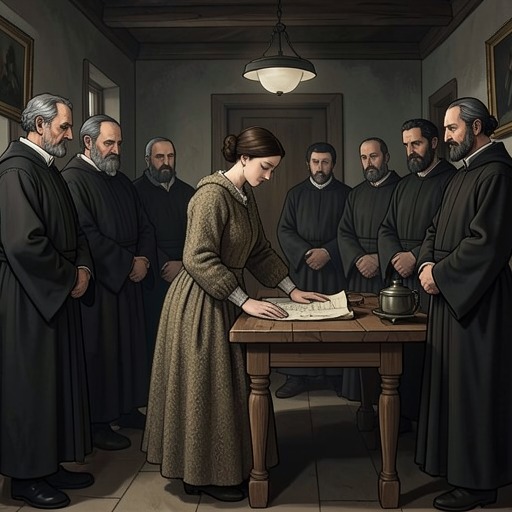
Cromwell understands an oath as a legal instrument that must be enforced, not simply announced. He plans to send people through towns and villages to swear men and women of consequence, including landowners and widows with inheritances, to uphold the succession of the child Anne is carrying. The intended reach is deliberately broad: even those who have barely heard of Anne Boleyn are to be bound by the settlement. The law’s success depends on people knowing enough to swear, and on officials being able to carry the requirement across the country.
This administrative ambition is set against a darker, older landscape in Cromwell’s imagination. The realm contains not only its visible communities and borders but also the uncounted dead and local spirits rooted in hedges, woods, holy wells, and burial places. The oath’s attempt to bind the country therefore becomes more than a policy for the living elite: it exposes the limits of any government that seeks to reach every place and every subject through official words.
Mary Tudor and Competing Claims
Mary Tudor’s situation gives the succession settlement its most intimate human consequence. When Cromwell visits her, she is living apart from court, without the recognition she believes her birth entitles her to. She asks how she can lawfully be excluded from the succession and appeals to a law above Parliament: the law of God. Cromwell answers that Parliament’s will determines the law in this matter. Their exchange sets competing sources of authority against one another—parliamentary enactment, divine law, and the claims of royal birth—without making Mary’s conviction disappear.
Cromwell distinguishes Mary’s legitimacy as a person born to parents who believed themselves married from the validity of the marriage itself. Mary accepts that he has stated a distinction, but insists that the marriage was in fact good. He urges her to greet Anne respectfully as her father’s wife, arguing that a public show of acceptance might restore her to court and improve her circumstances before Anne gives birth. Mary refuses the underlying identification of Anne as queen and calls her father’s wife a concubine. Her refusal is therefore not simply a personal quarrel: it bears directly on whether she will recognize the settlement that makes her own status precarious.
Mary also understands the political danger in the prospect of Anne’s child. She believes Anne fears that Mary might marry and that Mary’s future sons could threaten the new queen’s position. Mary has herself been repeatedly discussed as a prospective bride in dynastic negotiations, and she tells Cromwell that she has been contracted in marriage many times. The succession settlement thus reaches beyond one unborn child: it reorganizes the expected futures of the king’s daughters and the possible alliances made through their marriages.
Oath, Authority, and Consequences
The oath’s significance lies in its claim that political words can alter obligations across the kingdom. Cromwell describes the work of drafting laws as testing words for their power to make things happen in the real world. But their efficacy depends on belief and enforcement: a penalty must be enforceable against rich and poor alike, in the border regions as well as in the southern counties. The oath is intended to bind people who may know little of the dynastic dispute, and its nationwide administration reveals the scale of the state-building project behind the succession policy.
The novel places this settlement amid a wider assertion of royal supremacy. In 1534, Cromwell presents Henry VIII with propositions from Marsiglio of Padua, arguing that the church’s claims to govern, legislate, tax, and dispose of property do not come from Christ, and that the prince’s authority is exercised through a legislative body acting for the people. That argument supplies a political rationale for placing marriage and legitimacy within the prince’s jurisdiction. It does not resolve the spiritual objection Mary raises; instead, it shows how the government seeks to make Parliament the operative authority in a conflict that its opponents understand in religious terms.
The succession oath also foreshadows the more explicit oaths and statutes that follow. Cromwell later seeks to swear people to uphold the succession, while the Act of Supremacy requires recognition of Henry VIII as head of the church and a further enactment defines denial of the king’s titles or jurisdiction as treason. The settlement’s logic therefore extends from succession into religious jurisdiction and the regulation of speech. Its words are meant not only to describe the kingdom’s order but to secure it—by creating obligations, defining disloyalty, and requiring the people of England to affirm a future that remains uncertain.